
Financing for Solar Energy: How does it work and where can I get a quote?
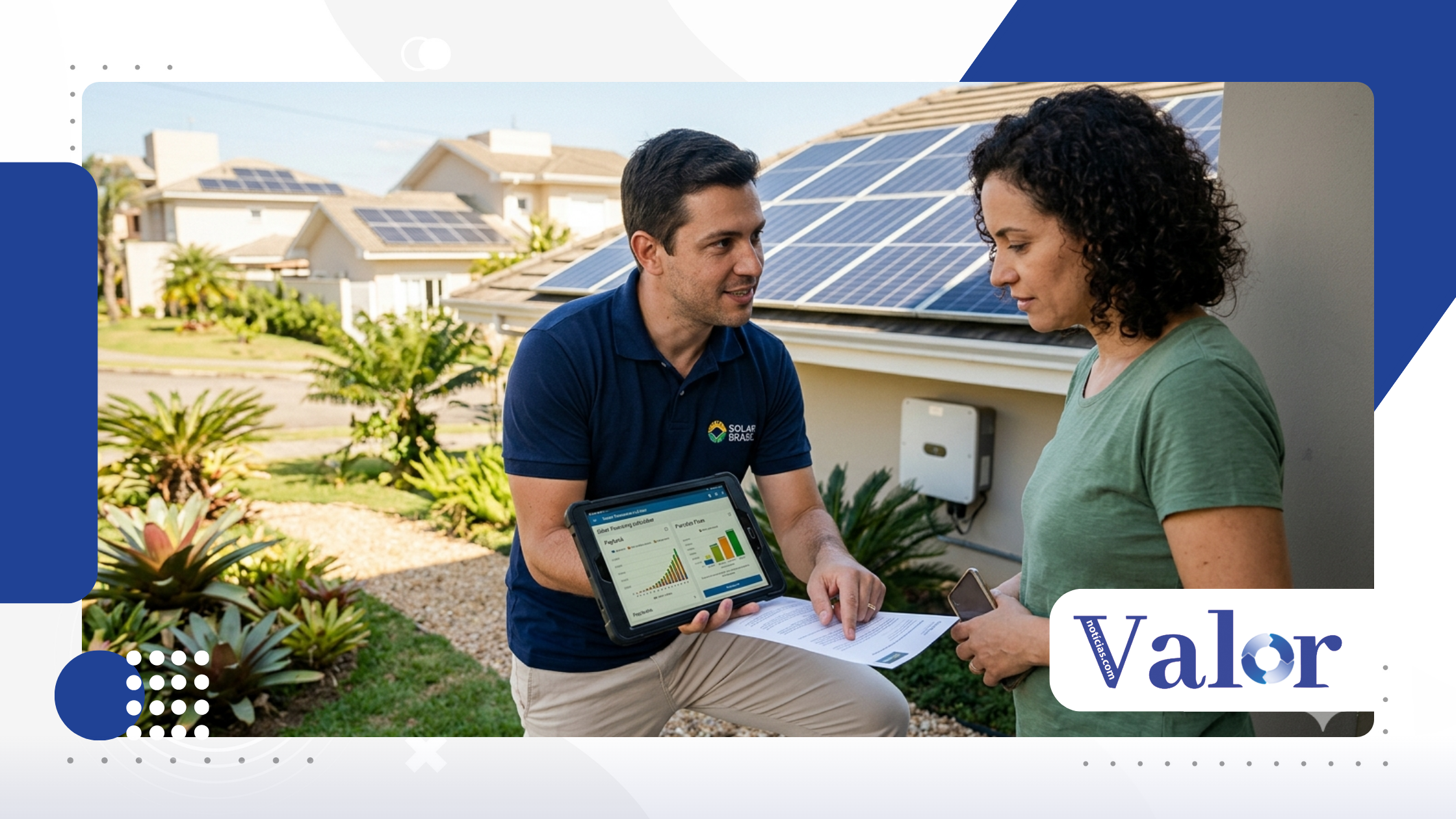
The photovoltaic sector has gone from being a futuristic promise to becoming the central axis of Brazil's energy independence by 2026.
Advertisements
Today, the financing for solar energy It's not just a bank loan, but a transfer of assets: you stop paying for a service you use and start investing in a self-generating asset.
As financial institutions have matured, credit lines have become more targeted, designed so that the savings on the monthly bill easily cover the cost of the installment.
It's a mathematical logic that rarely fails when the project is well executed.
In this guide, we delve into the practical workings of these methods, the criteria that truly determine approval, and the quickest ways to simulate your project with the precision that today's market demands.
Summary
- The mechanics of solar credit in 2026
- What do banks really look for in your application?
- Ways to simulate without falling into traps.
- Technical overview: Market comparison
- The payback strategy: Beyond the electricity bill
- Essential Questions (FAQ)
How will financing for solar energy work in 2026?
Forget about that bureaucratic mess from five years ago. Nowadays, the financing for solar energy It operates under a cash flow mechanism where the system pays for itself.
It's a reversal of priorities: the capital that would be drained monthly by the concessionaires is redirected to pay off a system that will be yours for decades.
Financial institutions are now using their own equipment as collateral in a large number of contracts.
This is not an irrelevant detail; this legal certainty is what allowed the plunge in interest rates that we see now, making solar credit much cheaper than any conventional personal loan.
The icing on the cake is the grace period structure. In 2026, it's common to find periods of up to 180 days before the first payment.
This breathing room is strategic: it ensures that your system is already generating energy and offsetting costs even before the first bill arrives in your email.
What are the main types of credit lines available?
The market has fragmented into very specific solutions, moving away from the "one size fits all" model.
We have options ranging from CDC (Direct Consumer Credit) for homes to BNDES (Brazilian Development Bank) loan programs which, although more bureaucratic, offer unbeatable costs for the industrial and agribusiness sectors.
For the average consumer, the focus has shifted from simply the interest rate to the flexibility of the loan term.
Terms of up to 96 months have become the standard, allowing installments to fit into the budget without straining household cash flow, something that is often misinterpreted as simply "indebtedness," when in fact it is inflation protection.
Credit cooperatives have also gained impressive ground.
They tend to offer more personalized service and rates that, because they don't aim for traditional banking profits, end up being extremely aggressive for those who are already members or intend to become one.
It is worth highlighting that the financing for solar energy Today it's modular.
You can finance everything from a basic panel kit to a complete project, including structural roof reinforcement and smart satellite monitoring systems, all within the same bank loan.
Where can I simulate and contract my photovoltaic system?
The starting point should not be the bank manager, but rather specialized portals that aggregate offers.
Major players in the retail banking sector have simulators that use your kWh consumption history to project, in real time, the impact of installment payments on your monthly income.
There are technology hubs that function as independent comparison sites.
When you enter your data, these platforms consult multiple institutions at the same time, delivering a ranking by Total Effective Cost (TEC).
Often, a low interest rate hides administrative fees that make the contract expensive in the long run.
Consulting these references helps to understand whether the macroeconomic climate favors fixed interest rates or whether it is worthwhile to take a risk on contracts linked to inflation indices.
The golden rule is to never accept the first offer.
The credit market in 2026 is highly competitive, and institutions have room to negotiate, especially if you present a competing simulation or have a technical project already validated by a responsible engineer.
++ Refinancing: when it can be a smart solution
What documents are needed for credit analysis?
To move forward with the financing for solar energyThe rigor in documentation still exists, but the delivery method has changed.
The bank will require proof of income, identification, and, crucially, your latest energy bills to verify if the size of the intended system matches your actual consumption patterns.
In the case of companies, the scrutiny is greater. The balance sheet for the last twelve months and the articles of incorporation are the basis, but what really drives the approval process is the technical feasibility study.
The bank needs to be sure that the savings generated are real and sustainable throughout the entire contract period.
Having a detailed quote from a reputable integration company is half the battle.
Banks prefer to finance projects that use equipment with recognized quality certifications, as this ensures that the guarantee (the panels) will not lose efficiency before the end of the payment period.
Credit score is still the deciding factor in final terms. A high score not only guarantees approval, but it's what separates promotional rates from standard rates.
If your score isn't excellent, a strategic entry might be worthwhile to reduce the perceived risk for the institution.
++ How to maintain financial health even after taking out loans.
Comparative Table: Solar Credit Overview 2026
| Credit Modality | Suggested Timeframe | Typical Shortage | Main Focus |
| Public Bank Lines of Credit | Up to 120 months | 120 to 180 days | Large sugar mills and agriculture |
| Private Banks (Retail) | Up to 96 months | 60 to 90 days | Homes and Businesses |
| Specialized Fintechs | Up to 72 months | 30 to 60 days | Fast Digital Approval |
| Regional Cooperatives | Up to 84 months | Negotiable | Local Producers |
The impact of tax reform on the cost of money.

The consolidation of the tax reform in 2026 brought a clarity that the sector hadn't had in a decade. The exemption of essential components and the simplification of VAT reduced the entry cost of projects, which directly reflects on the amount you need to borrow.
With the drop in equipment costs, the financing for solar energy It is now requested for smaller amounts, which reduces the time of exposure to credit and improves the consumer's risk profile.
It's a virtuous cycle: cheaper projects generate shorter and healthier financing.
Investors now see solar energy as a hedge against the volatility of energy prices.
While the cost per kWh continues to be pressured by climate crises, the value of your financing installment remains static, protecting your purchasing power.
This new tax reality has also made life easier for financial institutions when auditing collateral.
With more transparent electronic invoices and unified taxes, the disbursement of capital to the installation company occurs in a much more fluid and secure way for the client.
How does installment payment dictate the pace of your payback?
There is a persistent myth that interest rates financing for solar energy They destroy the profitability of the project.
In practice, what happens is a dilution of the investment. Although the total nominal cost is higher than the cash cost, the return on equity is usually superior, since you haven't "tied up" your money.
By extending the payment term, you can align the installment payment with the amount you were already paying for electricity.
In practice, your energy bill simply changes recipient: it stops going to the distributor and starts going to the bank, with the fundamental difference being that, after a few years, this expense simply disappears.
The technology of the modules in 2026 guarantees minimal degradation.
This means that even after paying off the financing in 5 or 7 years, you will still have at least two decades of virtually free energy generation, since the maintenance cost of modern systems is negligible.
Solar credit should be viewed as a leverage tool.
You use the bank's capital to build a small "power plant" on your roof which, in addition to saving money, increases the value of your property by a rate that often exceeds the total amount paid in financing.
The decision between borrowing and using equity capital.
Many hesitate between financing or paying cash. The issue here is purely one of opportunity: if you have the capital, but it's generating returns in investments that exceed the effective cost of financing, it doesn't make sense to divest.
THE financing for solar energy It preserves your liquidity for emergencies or other business ventures.
In 2026, credit lines for clean energy are treated as "green credit," possessing benefits that other modalities do not have.
Often, the bank offers fee waivers on other accounts or credit card upgrades simply because you have signed up for a sustainable solution.
Beyond the financial aspect, there's the issue of insurance. Well-structured financing contracts already come with policies that cover hail, strong winds, and electrical damage.
It's a layer of peace of mind that protects your investment against the climate uncertainties that have become so common.
Opting for credit is, above all, a choice of modernity.
It's about understanding that energy is no longer a variable and uncontrollable cost, but an input that can be managed intelligently, predictably, and with a real commitment to the health of your wallet and the planet.
++ The importance of comparing rates before taking out credit
Conclusion
The journey towards energy self-sufficiency through financing for solar energy This reflects the maturity of a consumer who no longer accepts being held hostage by tariff flags and arbitrary annual adjustments.
Credit is the bridge that transforms what was once a luxury into a strategy for economic survival and environmental responsibility.
By navigating through the simulation options and understanding the technical nuances of each contract, you take control of your consumption.
The sun is a democratic source; funding is merely the tool that allows that light to begin working for you much sooner than you ever imagined possible.
To delve deeper into the infrastructure guidelines and incentive policies that support the growth of this sector, we recommend following the updates from [website/source]. Ministry of Mines and Energy, where the new resolutions for 2026 are published transparently.
FAQ: What you still need to know
1. Can financing be denied because of the roof?
Not directly, but the bank requires that the technical project be approved. If the roof does not have the structural integrity to support the panels, the installation company must include the reinforcement in the budget, which may increase the amount financed.
2. What happens if inflation rises significantly during the payment period?
If your contract has a fixed term, you are protected; your payment will not change. If it has a variable term, the payment may fluctuate.
By 2026, most experts recommend flat rates to ensure that energy savings continue to outweigh the cost of credit.
3. Can I finance the system for a rented house?
Yes, provided there is consent from the owner or the system is installed using a "remote generation" model.
Another option is the leasing system, but in traditional financing, the link is usually made to the CPF/CNPJ (Brazilian individual/company tax ID) of the electricity account holder.
4. Are there any direct government subsidies in 2026?
Beyond direct cash subsidies, the government is working to reduce IPI and ICMS taxes on equipment, as well as offering subsidized interest rate lines of credit through regional development banks, focused on meeting decarbonization targets.
