
Home office and finances: how to balance expenses while working from home
Home office and finances: Did you know that working from home can increase your budget by around 25%? See how to balance expenses while working from home
Advertisements
This happens because the consumption of energy, water and cooking gas increases.
But it is possible to control these expenses and make your remote work more economical.

It is crucial to understand the finances of the remote work to improve your efficiency.
As household expenses increase, there are strategies to help control spending.
Let's see how personal finance and remote work affect your budget and productivity.
Main Points
- Working from home can increase your household budget by approximately 25%.
- Unused electronic equipment can account for up to 30% of the increase in your energy bill.
- Making meals at home can result in significant savings.
- Proper food management avoids waste and unnecessary expenses.
- Reducing the use of transportation, food, and clothing can be a financial advantage of working from home.
- Maintaining a financial reserve is essential to face economic crises.
- Using energy and water responsibly at home can generate significant savings.
Understanding the Financial Impacts of Working from Home
The shift to working from home has brought major financial changes to businesses and families.
Companies across a variety of sectors save a lot of money by working from home.
For example, micro-enterprises save around R$1,000 per month.
Large companies, such as the City of São Paulo, also save a lot.
They expect to save R$1 billion over seven years, thanks to reduced costs on renting rooms and offices.
The average rental price for a 30 square meter room is R$ 1,370.40 per month.
This is according to the FipeZap Commercial Index.

For companies, the benefits of working from home include lower water, electricity, and internet costs.
During the pandemic, many companies had to switch to home office.
This helped to plan better for the future.
Indirect operating costs were one of the first financial impacts.
This has happened to teams working from home.
A major advantage is efficiency and savings on physical spaces.
Unused office space can be repurposed or eliminated, significantly reducing costs.
Expenses for travel and corporate dinners have decreased.
There's also less spending on holiday parties and office coffee.
“The importance of IT resources has increased with teleworking.
This has resulted in the need for more investment in digital security and quality technological infrastructure,” say industry experts.
On the other hand, working from home brings extra expenses.
Internet, computer systems, and software costs have increased, resulting in a substantial increase in spending.
Companies need to do budget adjustments to adapt.
It is essential to balance technology investments with savings.
This requires constant re-evaluation of the family budget and business.
A critical effect is the competitive nature of compensation.
With home office, remuneration has become globalized.
Organizations are adjusting their budgets to reflect these new cost dynamics.
| Item | Before Home Office | After Home Office | Difference |
|---|---|---|---|
| Commercial Rental (30m²) | R$ 1,370.40 | R$ 0.00 | -R$ 1,370.40 |
| Transportation Expenses | R$ 600.00 | R$ 0.00 | -R$ 600.00 |
| Internet expenses | R$ 0.00 | R$ 150.00 | +R$ 150.00 |
| General Office Expenses (water, electricity, etc.) | R$ 500.00 | R$ 0.00 | -R$ 500.00 |
Tips for Saving Energy in the Home Office
Save energy in the home office is crucial to control costs.
LED lamps can reduce energy consumption by up to 80% compared to traditional lamps.
++ Income Tax 2025: step-by-step guide to error-free filing
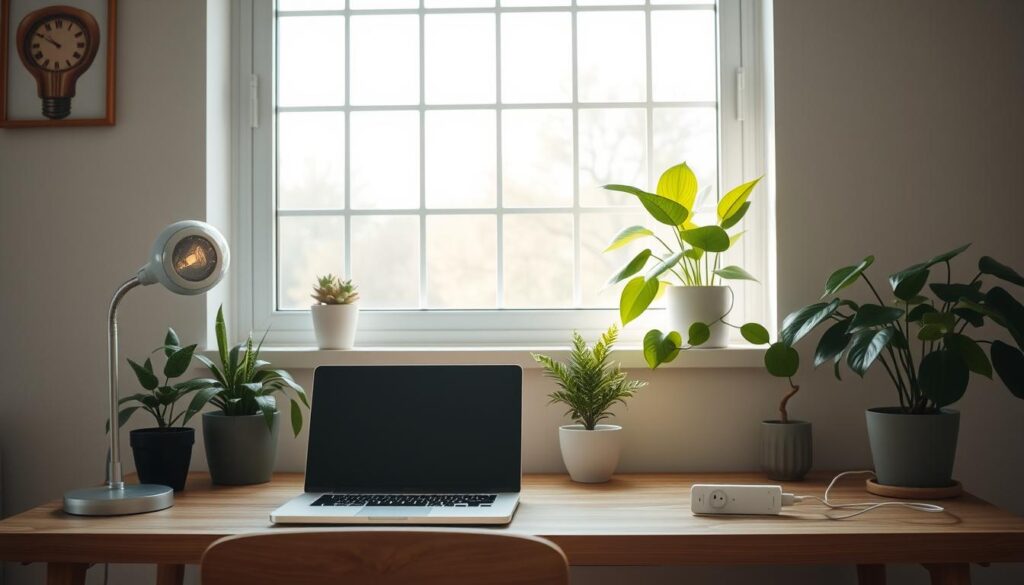
Taking advantage of natural light by opening windows and curtains is a sustainability tip effective.
An inverter air conditioner can be up to 60% more economical than older models.
Keeping the temperature between 23º and 24º is ideal for saving money.
Choosing a ceiling fan is more economical than constantly using air conditioning.
A computer monitor consumes about 70% of the equipment's power when turned on.
Turn it off when not in use to avoid wasting money.
Avoiding leaving appliances on standby also helps reduce energy costs in the home office.
Old appliances need attention.
Keeping them in good condition prevents wasting energy.
When buying new ones, choose those with the Procel seal, which ranges from A to D in energy efficiency.
| Equipment | Consumption in kWh per Month | Savings Tip |
|---|---|---|
| Air conditioning (9,000 BTUs) | 128 kWh | Use a ceiling fan |
| Microwave | 14 kWh (used 20 min/day) | Use the gas stove |
| Electric Shower (summer mode) | Consume up to 30% less | Prioritize low temperatures |
| Electric Cooktop | 70 kWh (used 1h/day) | Prefer gas stove |
Adopt these sustainability tips not only reduces costs, but also promotes a conscious lifestyle.
Small changes in your daily routine can make a big difference at the end of the month.
Controlling Food Expenses
Working from home can increase supermarket expenses if we don't plan well.
Previously, many people spent R$600.00 per month away from home. With a good meal planning, we can save money and take care of our health.

To save on food, avoid impulse buying.
Make a weekly shopping list and stick to it.
It is also useful to take advantage of promotions and buy larger quantities of non-perishable foods.
Cooking at home is essential. Not only is it healthier, but it also helps us control what and how much we spend.
Plan what you're going to eat for the week and use fresh, seasonal ingredients, which are cheaper.
Monitor your spending regularly. Using apps like GuiaBolso and Organizze can be very helpful.
They allow you to record all expenses and adjust the budget when necessary, ensuring a savings on food effective.
See below a comparison between food costs before and after adopting home office:
| Situation | Average Monthly Cost |
|---|---|
| Before Home Office (eating out) | R$ 600.00 |
| During Home Office (eating at home) | R$ 700.00 |
++ How Economic Cycles Affect Small Businesses
Investing in Quality Equipment and Furniture
Invest in home office furniture and high quality equipment is very smart.
This is because the ergonomics at work and legal requirements are very important.
Law 13,467 establishes that teleworking has the same rights and obligations as the traditional CLT contract.
Additionally, employers must pay expenses related to employees working remotely.
With the COVID-19 pandemic, many employers have had to change their remote working practices.
Article 2 of the CLT states that infrastructure costs, such as internet and electricity, are the employer's responsibility.
It is essential to invest in equipment and suitable furniture.
Studies show that productivity increased greatly when working conditions were improved.
Therefore, the cost assistance of around R$ 218.00, used in home office kits, can be very important.
“If the employee's equipment is not adequate, the company must bear the costs of purchasing new equipment.”
This highlights the importance of discussing who will pay for and maintain the equipment in the teleworking contract.
Furthermore, the ergonomics at work is crucial.
Ergonomic furniture, such as adjustable chairs and tables, helps prevent health problems and increases productivity.
| Sector | Percentage of Remote Professionals |
|---|---|
| Business | 22,7% |
| Manufacturing industry | 20,2% |
| Services | 13,4% |
| Construction | 40,9% |
Finally, invest in ergonomic equipment and home office furniture is a smart strategy.
It's not just a cost, but a way to ensure better results and the well-being of workers.
Home Office and Finances: Creating an Effective Family Budget
One family budget done well is crucial for a healthy home office.
During crises, it is essential to control expenses to maintain balanced finances.
People who manage their finances well recover faster from economic crises.
To make a budget, list all your sources of income and expenses. Divide them into essential and non-essential.
Reviewing and adjusting your expenses monthly helps you avoid debt and stay in control.
Creating an emergency fund is an important step.
This fund should cover three to six months of expenses. Investing in stocks, real estate funds, and direct treasury bonds is also recommended.
| Monthly Expenses | Value |
|---|---|
| Office Supplies | R$ 200 |
| Internet | R$ 150 |
| Food | R$ 600 |
It's vital to prioritize essential expenses. About 50% of household expenses go to housing and utilities.
Food and leisure can represent 30-40% of expenses, often exceeding what was planned.
Monitoring expenses helps you save up to 15% monthly.
Using digital tools to control expenses makes things much easier.
Budgeting apps improve financial organization for 70% families.
They help achieve financial goals.
Online courses on platforms like Udemy and Coursera offer valuable insights into personal finance.
They help keep finances under control.
Remember, a good budget is essential for financial stability and avoiding stress over unexpected expenses.
Economic Strategies for Remote Work
With the remote work becoming more common, it is crucial to use savings strategies to make the most of it.
Setting clear financial goals is one of the finance tips most important.
Plan your budget, including all the costs of working from home, such as energy and internet.
Digital tools like Trello and Asana help you organize tasks and manage your time.
They ensure the team is aligned and financial goals are met.
Techniques like Pomodoro also improve productivity and reduce fatigue.
Reviewing your expenses regularly is essential.
Check if there are ways to save money without losing efficiency in remote work.
Having a dedicated workspace helps increase productivity and improves finances.
| Strategies | Advantages | Recommended Tools |
|---|---|---|
| Setting financial goals | Guide to economic decisions | – |
| Use of digital tools | Efficient organization and management | Trello, Asana |
| Pomodoro Technique | Increased productivity | – |
| Spending review | Cost reduction | – |
| Dedicated workspace | Greater concentration | – |
Follow these finance tips and savings strategies can do the remote work be more sustainable.
This way, you can control your expenses and enjoy the benefits of this type of work.
++ How does the dollar affect product prices in Brazil? Learn more!
Financial Control Tools for the Home Office
With home office, finances have become more complex.
Using digital tools is essential. They help you organize your expenses and see how your investments are doing.
You budgeting apps are crucial for a financial control effective.
| Tool | Main Features | Benefits |
|---|---|---|
| Microsoft Teams | Up to 300 users, 10GB storage | Efficient team coordination |
| Zoom | Video conferences with up to 100 participants, webinars | Ease of remote meetings |
| Slack | Communication across channels, unlimited messages | Speed and efficiency in exchanging information |
| Artia | Task management, no frame limit | Workflow organization |
| Bling | Accounts payable and receivable, issuing of bills | Consolidated view of financial health |
| Myfinance | Budget planning, cash flow | Versatility in financial functions |
| Tiny | Inventory management, e-commerce integration | Ease of sales control |
These financial tools can change your home office routine.
They make the financial control more precise and organized.
You budgeting apps are essential to avoid surprises and maintain financial health.
Home office and finances: Conclusion
Working from home has become an essential option, especially with the coronavirus pandemic.
It brings benefits to both employers and employees. Since 2012, the number of remote workers in Brazil has grown by 44.4%.
This digital shift has helped companies become better organized.
They've become more agile. This shows that digital transformation is important.
Companies that adopt home office see positive results.
They save on overhead costs and have more flexibility. This reduces turnover by 25% and saves money.
This allows for investment in better equipment, improving the work environment.
Additionally, working from home helps save R$267 billion a year in traffic congestion.
To be successful working from home, it's crucial to review your financial strategies.
Careful planning improves employees’ quality of life.
And improves the efficiency of operations.
Going forward, reviewing and adjusting strategies is essential.
This ensures a win-win remote work experience for everyone.
