
Financial Spreadsheet: How to Create and Use One to Control Your Expenses

Financial Spreadsheet: Maintaining efficient control of personal finances is one of the pillars for achieving economic stability and long-term planning.
Advertisements
However, without proper organization, it can be difficult to visualize where the money is going.
A well-structured financial spreadsheet can be the ideal solution for monitoring income, expenses, and investments in a clear and accessible way.
But how do you create and use this tool effectively?
In this article, we will explore the importance of the financial spreadsheet.
As well as how to set it up correctly and best practices to ensure you're in complete control of your budget.
Why use a financial spreadsheet?

Managing money intuitively can be a huge challenge, especially when you have multiple sources of income and different expense categories.
With a financial spreadsheet, you can view all financial transactions in an organized way.
In this sense, it facilitates decision-making and avoids unpleasant surprises at the end of the month.
Plus, by recording all your expenses and income, you'll have a clear idea of where you can save.
Small daily expenses that go unnoticed can add up to a big impact over time.
The financial spreadsheet allows you to identify these superfluous costs and eliminate them, promoting more efficient financial management.
Another crucial point is predictability financial.
With a detailed history of your spending, you can plan for future expenses and build up emergency reserves.
This way, you reduce the risk of debt and build a more solid and sustainable financial plan.
How to create an efficient financial spreadsheet?
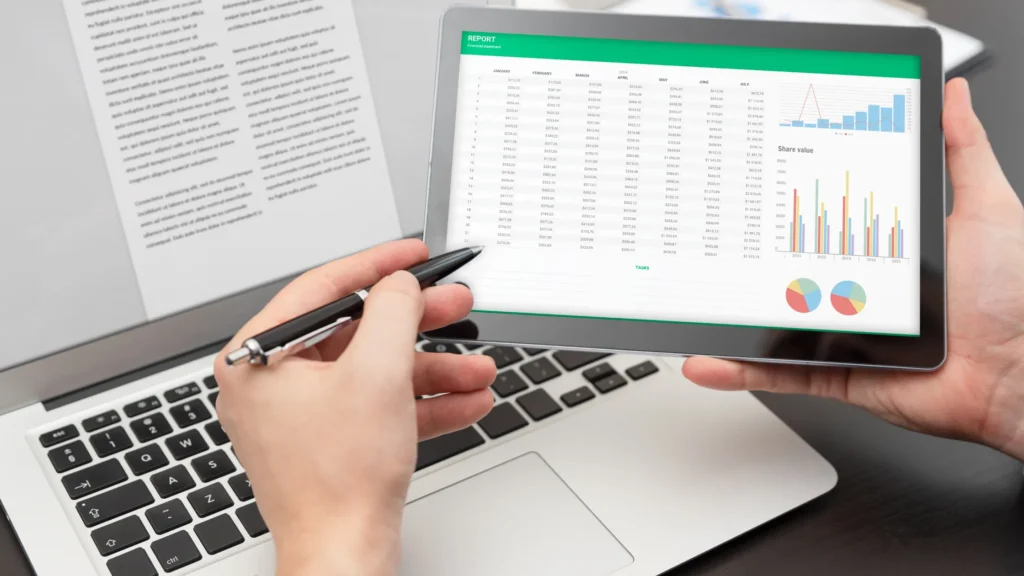
Creating a financial spreadsheet isn't complicated, but it requires attention to some fundamental aspects.
The first step is to define what information should be recorded.
In general, an efficient spreadsheet needs to contain:
- Revenues: salary, bonus, investment income, among other sources of income.
- Fixed expenses: rent, condominium fees, electricity, water and internet bills.
- Variable expenses: food, leisure, transport, various purchases.
- Investments: financial investments, private pensions, asset purchases.
- Emergency reserve: savings or funds set aside for unforeseen events.
The basic structure of the spreadsheet can be done in Excel, Google Sheets, or any other similar software.
An initial template might follow the format of the table below:
| Category | Description | Value (R$) | Date |
|---|---|---|---|
| Wage | Monthly remuneration | 5.000,00 | 01/04/2024 |
| Rent | Fixed expense | 1.500,00 | 05/04/2024 |
| Supermarket | Food | 600,00 | 10/04/2024 |
| Transport | Gasoline | 300,00 | 12/04/2024 |
| Leisure | Dinner with friends | 200,00 | 15/04/2024 |
| Investments | Contribution in shares | 500,00 | 20/04/2024 |
Once you've set up this database, it's essential to maintain the discipline to update the spreadsheet regularly.
Consistency is what makes this tool truly effective in budget management.
How to use the spreadsheet to control expenses?

Creating the financial spreadsheet is just the first step.
For it to be effective, it must be used correctly and reviewed frequently. A common mistake is to enter values only once a month.
In this sense, the ideal is to record each expense as soon as it occurs, avoiding forgetfulness and making records more accurate.
Another important aspect is the categorization of expenses.
If possible, subdivide expenses into more specific groups, such as “Food – Restaurants” and “Food – Grocery”.
In short, this makes it easier to analyze where consumption is highest and where adjustments can be made.
Additionally, the spreadsheet should serve as an analysis tool.
At the end of each month, compare your expenses and income, checking consumption patterns and savings opportunities.
If expenses exceed income, it is a sign that adjustments need to be made to avoid debt.
Tips for optimizing your financial spreadsheet
Even if you have a well-structured spreadsheet, some best practices can further improve its use and ensure you reach your financial goals.
Some of these tips include:
- Automate calculations: uUse formulas to automatically add income and expenses, making analysis easier.
- Set financial goals: thisSet spending limits for each category and monitor your progress.
- Create tracking charts: visUsing data graphically makes it easier to identify patterns.
- Use colors to highlight important information: cateTrack income and expenses in a visually intuitive way.
The table below illustrates an example of a monthly summary that can be included in the spreadsheet to make it easier to view the results:
| Month | Total Revenue | Total Expenses | Final Balance |
|---|---|---|---|
| January | 5.500,00 | 4.200,00 | 1.300,00 |
| February | 5.200,00 | 4.500,00 | 700,00 |
| March | 5.000,00 | 4.800,00 | 200,00 |
| April | 5.000,00 | 4.600,00 | 400,00 |
Common mistakes when using a financial spreadsheet and how to avoid them
Even with a well-structured spreadsheet, many users make mistakes that compromise its effectiveness.
Knowing these mistakes and how to avoid them is essential to ensuring efficient financial control.
1. Not updating the spreadsheet regularly
One of the most common mistakes is forgetting to record income and expenses as they occur.
In fact, this can lead to a lack of control and distort the real financial situation.
To avoid this problem, make a habit of filling out your spreadsheet daily or at least weekly.
Therefore, applications that allow you to access spreadsheets via your cell phone can make this process easier.
2. Not categorizing expenses correctly
Recording all expenses in a single generic category makes it difficult to analyze financial habits.
The ideal is to detail expenses into specific subcategories, such as “Transportation – Fuel” and “Food – Restaurants”.
This way, it is easier to identify where adjustments are needed.
3. Ignoring small expenses
Many people neglect small things, like a daily coffee or a bank fee, because they seem insignificant.
However, these costs accumulated throughout the month can represent a considerable part of the budget.
Writing down all your expenses, no matter how small, helps you get a more accurate picture of your finances.
By avoiding these mistakes, your financial spreadsheet will become an even more powerful tool for planning and managing your money.
With this type of perspective, it's easier to understand your financial progress over the months and adjust your habits as needed.
Conclusion
Keeping a financial spreadsheet can be the key to a more organized and healthy financial life.
With proper planning, you can control your spending, identify savings opportunities, and ensure a more stable financial future.
The most important thing is to get into the habit of updating and analyzing data regularly.
Small adjustments to your daily routine, such as avoiding unnecessary expenses and investing wisely, can make a big difference in the long run.
So, if you don't already use a financial spreadsheet, start today and take the first step towards more efficient financial management!
