
The Importance of Accounting in Financial Risk Management

Importance of Accounting in Financial Risk Management: Have you ever wondered how some companies survive in difficult times?
Advertisements
The answer is in the good financial risk management.
THE accounting is key to identifying, measuring and reducing risks.
You financial risks are varied, such as market and credit risks.
An increase in the number of defaulters may be a sign of credit risk.
A drop in cash flow may indicate liquidity problems.
To deal with these risks, financial ratios are essential.
For example, the current ratio and return on investment help assess risk.
Sensitivity analysis and Value at Risk (VaR) are important techniques for understanding and predicting risk.
THE accounting helps companies make informed decisions.
This allows them to prepare for risks.
Having accurate accounting data is essential to avoid problems and ensure business growth.
Main Points
- THE accounting is essential in financial risk management, helping in the identification and risk mitigation.
- You financial risks cover markets, credit, liquidity and operational aspects.
- Financial ratios such as current ratio and return on investment are crucial in risk assessment.
- Sensitivity analysis and Value at Risk (VaR) are used to quantify risks and predict financial impacts.
- Decisions based on reliable accounting information help prevent new risks.
Understanding Financial Risks
You financial risks are uncertainties that can negatively affect the financial health of companies.
They cover several types of financial risks, such as market, credit, liquidity and operational ones.
These risks can come from external or internal factors, affecting the economic stability of companies.
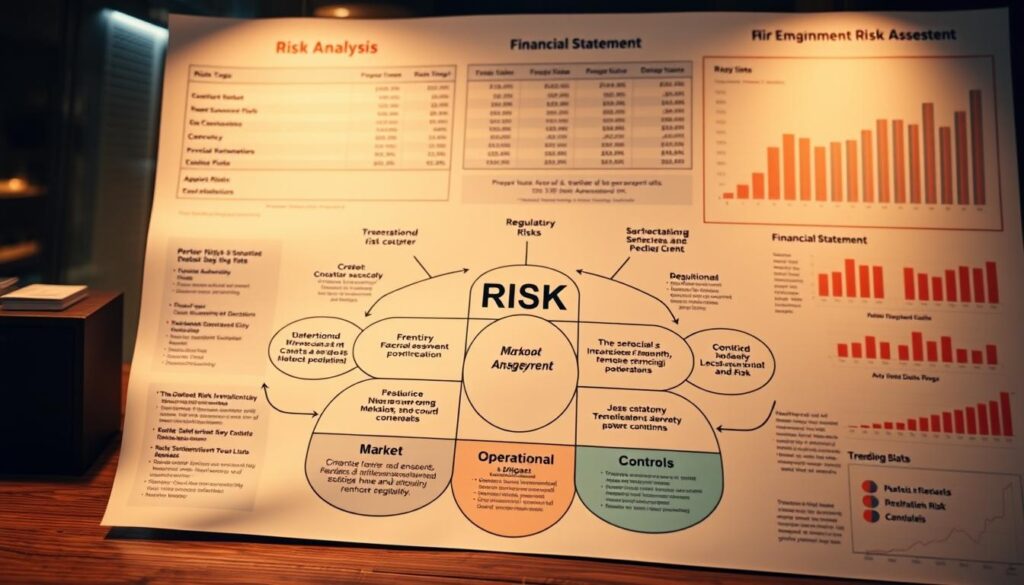
Companies that manage their financial risks They can reduce losses and find new opportunities. Compliance with financial and tax laws in Brazil is complex.
A good one risk management avoids expensive fines.
It is crucial to identify types of financial risks before they happen.
This involves analyzing credit operations and practices.
Monitoring customer payments and credit terms helps avoid credit risks.
Analyzing market trends and economic news helps monitor market risk.
Managing cash effectively and making accurate cash flow forecasts are essential to avoiding liquidity risks.
Internal audits and process reviews help identify operational risks.
Complying with laws such as the Anti-Corruption Law and the LGPD protects against penalties and reputational damage.
THE financial health and the stability of a company depend on a good risk management.
Tools like SWOT analysis and the Risk Matrix help quantify risks and define priorities.
Creating reserve funds and reviewing strategies periodically are best practices.
The Role of Accounting in Risk Management
Accounting is essential in financial risk management.
It provides accurate data for decision making.
With this data, we can identify financial problems, such as lack of liquidity and high debt.
Between 2019 and 2023, 18 articles were published on the topic.
They show the importance of accounting in decision making.
ISO 31000 provides a complete framework for managing risks, including identification and analysis.
The Sarbanes-Oxley Act of 2002 (SOX) requires regular audits.
This helps maintain transparency and compliance.
The COSO model is also important, with five components for effective internal control.
An internal control system is crucial.
Without it, serious problems can arise.
Accounting helps to identify and reduce these risks, being essential in financial management.
Accounting-Based Risk Identification
THE risk identification is essential in financial management.
Accounting helps identify risks by analyzing changes in expenses and revenue. This can indicate financial problems and allow for quick action.

Accounting helps uncover fraud and errors. It analyzes financial transactions to find unusual patterns. These patterns can be signs of risk.
According to CFC Resolution No. 1,528 of 2017, risk management is part of Strategic Planning.
It seeks to improve the capacity for appreciation and ensure the achievement of objectives.
The policy includes the risk identification financial and the implementation of effective internal controls.
See the table below to better understand the management of financial risks:
| Metrics | Description | Impact |
|---|---|---|
| Current Liquidity Ratio | Measures the company's ability to pay short-term debts with current assets. | Liquidity problems |
| Debt Ratio | Assesses the ratio of debt to the company's equity. | Credit risk |
| Return on Investment (ROI) | Measures the profitability of investments made by the company. | Financial performance |
| Value at Risk (VaR) | Quantifies the risk of loss in an investment portfolio. | Market risk |
Financial reports transparent reduce the risk of litigation and sanctions.
Segregation of duties reduces the risk of fraud by up to 60%.
These practices are essential for the financial health of the company.
In short, accounting analysis is crucial to identifying financial risks.
It allows for effective and proactive management, aiming at the company's stability and growth.
++ Artificial Intelligence and Finance: How AI is Changing the Financial Market
Risk Measurement and Assessment
Risk management is essential to the success of any company.
We use financial indicators and analysis tools to understand risks.
We evaluate the frequency and the gravity of each risk to make an accurate analysis.
Control Self Assessment (CSA) is an important method for measuring risk.
It is decentralized and evaluates the effectiveness of controls.
Using process mapping and checklists, we identify risks and assess exposure.
To measure control levels, we use control effectiveness.
We created a control performance index.
This index shows how controls mitigate risks.
With the risk matrix, we categorize the risks.
We identify high risks that require rigorous controls. We also see low risks that indicate adequate controls.
| Frequency | Gravity | Risk Category |
|---|---|---|
| High | High | Critical |
| High | Average | High |
| Average | Average | Moderate |
| Low | Low | Low |
Managing risk involves balancing levels of control and costs.
According to the COSO framework, we must consider available resources.
This helps decide the best controls for each risk.
Financial Risk Mitigation
Managing financial risks is essential for a company's stability.
Control policies and hedging strategies are fundamental.
The Anti-Corruption Law increased the number of complaints, highlighting the need for a good governance system.
Companies using foreign exchange contracts can hedge against fluctuations.
Credit risk management is also crucial. This includes properly assessing credit and monitoring the financial health of debtors.
Automation can save up to 75% in reconciliations.
Standardizing accounting closing processes helps avoid errors. Diversifying operations is essential to avoid significant losses.
Cyberattacks and system failures are on the rise.
Information security and data usage are vital. Today, data is more valuable than any other currency.
Good financial governance includes a qualified team and clear processes.
Transparency is crucial so that everyone is aware of the risks and actions to mitigate them.
| Measure | Description | Benefit |
|---|---|---|
| Process Automation | Implementation of technology to automate repetitive tasks. | Savings of up to 75% in reconciliations. |
| Exchange Contracts | Use of contracts to fix exchange rates in international transactions. | Protection against adverse exchange rate fluctuations. |
| Credit rating | Rigorous analysis of the financial capacity of debtors. | Reduction of default risk. |
| Process Standardization | Creation of consistent procedures for accounting closing. | Minimization of human errors. |
| Diversification | Reduced dependence on a few suppliers or markets. | Protection against considerable losses. |
| Cybersecurity | Implementation of measures against cyberattacks and data loss. | Prevention of financial and regulatory damage. |
Accounting as a Strategic Ally
THE strategic accounting goes beyond traditional tasks.
It acts as a crucial partner, providing essential data for financial management.
By analyzing reports such as balance sheets and income statements, you can assess financial performance and plan for the future.
This helps in sustainable growth.
Companies that want to grow know that complying with the law is essential.
This avoids legal issues and fines. Taxes such as ICMS, ISS, IRPJ, and CSLL are part of the complex tax system that must be carefully monitored.
To achieve the sustainable growth, it is important to have strategic partners in management accounting.
Financial indicators, such as profit and ROI, are fundamental to defining the price of products and services.
They are also essential for the financial health of the company.
Management accounting must look to the future. It must provide quality information to assess performance and set goals.
The relevance, reliability, comparability and understandability of this information are crucial for strategic decision-making.
Therefore, well-structured and strategic accounting is essential for the success of companies.
It strengthens the ability to foresee the future and deal with risks. This ensures a promising and solid future.
++ How to Choose an Accountant for Your Business or Personal Finances
Importance of Accounting in Risk Management
Accounting is essential to manage risk.
It helps you make strategic decisions based on reliable data.
This is crucial for the success of companies in a dynamic market.
Following accounting principles improves the relationship between accountants and clients. This helps maintain client satisfaction.
Additionally, data accuracy is critical to making quick decisions.
Transparency in accounting is essential. This means displaying all requested data clearly.
Accurate reporting is essential for a strategic management effective.
It's important to present information appropriately. This ensures that the data is accurate and relevant.
Accounting helps reduce risks using technology and strict laws.
You financial reports help understand trends and profitability. For example, ROI and IRR are useful for evaluating investments.
| Accounting Benefit | Description |
|---|---|
| Budget Planning | Set financial goals and establish actions to achieve them. |
| Budget Control | Identifies areas for cost reduction and resource optimization. |
| Accounting Analysis | Detects financial threats and market opportunities. |
| Legal Compliance | Ensures that the company is in compliance with tax laws. |
| Decision-Making Support | Allows for well-informed strategic decisions. |
Practical Applications of Accounting in Risk Management
Accounting is essential in business management. It helps reduce risks and seize opportunities.
Companies that manage risks well can reduce financial losses by up to 30%.
With sound accounting practices, companies can identify problems before they cause damage. This helps avoid major losses.
Conducting regular audits is a very effective accounting practice. Companies that conduct frequent audits face fewer regulatory issues.
They also reduce the chance of fraud by up to 40%.
Analyzing financial statements helps detect problems.
For example, over-reliance on a single customer can account for up to 30% of a company's revenue.
Maintaining regulatory compliance is crucial to avoiding fines.
These fines can reach 20% of annual revenue.
Transparency in operations increases investor confidence by up to 40%.
Transparent companies also have more successful negotiations, resulting in a return on investment (ROI) of up to 200%.
Investing in internal controls is vital. Companies without internal controls face a higher risk of fraud.
Those that invest in control and transparency improve the accuracy of financial information by up to 40%.
Managing crises strengthens a company's reputation. This is crucial, as 70% of companies that face reputational crises do not fully recover.
Using risk analysis to make business decisions helps identify areas for growth.
Companies that do this are 50% more likely to succeed.
This is important during periods of low demand and unexpected fluctuations in cash flows.
| Benefits of Risk Management | Percentage (%) |
|---|---|
| Reduction of Financial Losses | 30% |
| Lower Likelihood of Regulatory Issues | 20% |
| Reducing the Possibility of Fraud | 40% |
| Increased Investor Confidence | 40% |
| Greater Organizational Stability | 80% |
Adopt practical applications efficient is essential.
Regular audits, regulatory compliance, and robust internal controls help mitigate financial risks.
This promotes long-term sustainable growth.
Accounting practices are essential for a stable and prosperous business environment.
Conclusion
Accounting is essential for managing financial risks.
It helps identify and mitigate threats before they become problems.
About 80% of managers believe that accounting is crucial for accurately budgeting and forecasting finances.
Companies that use financial reports in real time can greatly improve your efficiency.
They can make decisions with current data.
This helps find trends and improve costs, reducing up to 50% of tax burden.
In short, good accounting management helps the company a lot.
It ensures compliance and helps growth.
Investing in modern accounting is essential to thrive in a competitive market.
