
Artificial Intelligence and Finance: How AI is Changing the Financial Market
Artificial Intelligence and Finance: Can artificial intelligence truly change the financial market? Or will it just be a passing fad? Find out now!
Advertisements
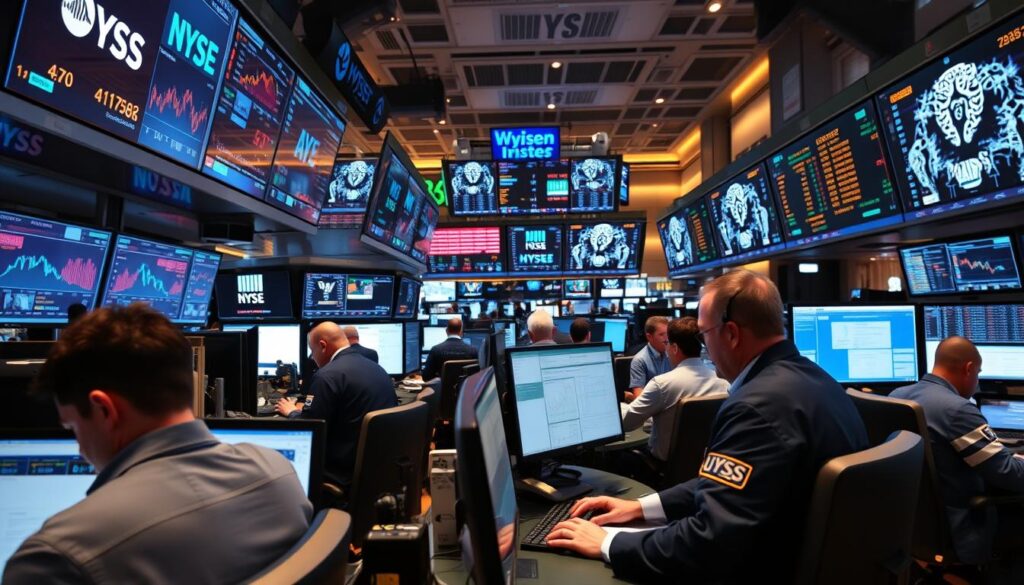
THE AI in the financial market is making a big impact.
It analyzes a lot of data, changing how finance operates.
THE financial technology is revolutionizing, increasing productivity by up to 900%, as shown by AIfred.
THE IA It not only automates processes, but also predicts what will happen in the market. This gives investors a huge advantage.
Trading robots now they make purchases and sales automatically.
They also monitor markets and analyze data, reducing costs by up to 94%.
Generali and others are already using AI to improve their daily operations.
THE AI in the financial market also helps in risk management.
It analyzes historical data to predict risks, helping institutions make better decisions and avoid losses.
Main Considerations
- AI analyzes large amounts of data to identify trends and opportunities.
- AI financial tools seek competitive advantages by predicting market behavior.
- Automation of purchase and sales orders with reduced costs and errors.
- Improved risk management with AI predictive analytics.
- Institutions like Generali are already seeing significant improvements in operations due to AI.
Introduction to Artificial Intelligence in the Financial Market
Artificial intelligence (AI) has changed the financial industry since the 1980s.
It uses machine learning algorithms to improve efficiency and results, across a variety of financial tasks.
For example, AI automates repetitive tasks, reducing costs and improving efficiency.
It also helps detect fraud, making transactions more secure.
AI analyzes data in real time, enabling fast and accurate trading.
This changes how we understand financial markets. It also helps with portfolio and risk management.
Additionally, AI personalizes financial services by offering investment recommendations.
AI-powered chatbots provide 24/7 support, enhancing the customer experience.
These innovations increase efficiency and return on investment.

| Solution | Benefit | Application |
|---|---|---|
| Process Automation | Reduction of operating costs | Banking Processes |
| Market Forecast | Better Portfolio Management | Investments |
| Fraud Detection | Greater Security | Banking Transactions |
| Chatbots | Personalized Service | Customer Service |
The more you use it AI and financial automation , the better the financial sector becomes.
It becomes safer, more efficient and meets global demands.
Automation of Financial Processes
THE financial automation is changing the banking industry.
It simplifies complicated processes and reduces human error.
With AI, tasks like bank reconciliations and stock trading become more efficient.
THE optical character recognition (OCR) extracts information from documents quickly.
Already the automatic natural language processing (NLP) improved contract management.
These technologies are not at the cutting edge financial automation .

A Sage study shows that 96% of CFOs expect major changes.
They believe AI will transform finance.
Additionally, 851% of CFOs see a more strategic role for themselves in the future thanks to AI.
A great benefit of financial automation is cost reduction.
Chatbots serve customers 24/7, requiring no human intervention.
This is a response to consumers' digital presence.
Machine learning algorithms improve data analysis.
They help accurately detect fraud. AI has also improved investment modeling.
| Benefits of Financial Automation | Description |
|---|---|
| Cost Reduction | Optimizing workflows and eliminating repetitive tasks |
| Customer service | Chatbots available 24/7, improving the user experience |
| Fraud Detection | Pattern analysis and real-time operation identification |
| Operational Efficiency | Using OCR and NLP for document and contract management |
| Data Analysis | Algorithms that process large volumes of data in real time |
AI is constantly evolving. It promises a future with greater innovation and efficiency in financial automation.
We are just beginning to see the potential of AI in banking and trading robots .
Data Analysis and Market Forecasting
Nowadays, the financial data intelligence is crucial to the success of companies.
It allows companies to see trends accurately.
This way, they can anticipate changes in the market and adjust their strategies quickly.

The postgraduate course in Data Science and Artificial Intelligence Applied to the Financial Market at PUC Minas is very comprehensive.
It lasts up to 18 months and covers topics such as Data Governance and Data Discovery.
Students learn about time series, machine learning , and neural networks.
They also learned how to use advanced tools to analyze large volumes of financial data.
The algorithms of machine learning are trained to find hidden patterns in historical data. This helps uncover opportunities and manage risks.
For example, they are used to predict asset prices and detect fraud.
An important point of the course is data analysis to make strategic decisions.
Students learn to design and implement models that automate market trend detection.
This skill is essential for developing trading algorithms and improving investment portfolios.
The course's faculty is made up of masters and doctors.
They offer quality training, with live online modules and recorded distance learning classes.
At the end, students receive a digital certificate from PUC Minas.
This certification proves that they have mastered the skills learned.
The union of technology and analytics is changing the future of the financial market.
++ Tips for Keeping Your Car in Good Condition Without Spending a Lot
Artificial Intelligence and Finance: Risk Management with AI
To the AI tools for risks have changed the way companies deal with financial risk management .
THE IA detects fraud with great accuracy, quickly identifying suspicious patterns.
This helps prevent damage before it happens. Large companies, such as BlackRock , use advanced algorithms to predict risks.
Today, technologies such as SAS Fraud Management and FICO Falcon use artificial intelligence.
They analyze large volumes of data and detect anomalies in seconds.
This greatly improves fraud protection.
These tools also help companies follow laws while maintaining a high level of financial compliance .
Furthermore, the IA helps companies predict market trends, allowing them to adjust their strategies before it's too late.
Software such as Alteryx and Tableau are leaders in this area, providing valuable insights to the financial risk management .
The use of AI tools for risks is also crucial for responding to unforeseen economic events.
Algorithms quickly analyze data, identifying emerging risks.
This allows for a quick and effective response.
The growing adoption of IA in finance shows the need for continuous training for professionals.
In conclusion, the IA is improving efficiency and risk management capabilities in the financial sector.
Tools like RiskMetrics and BlackRock Aladdin are just the beginning.
They promise a future where the financial risk management will be more accurate and reliable, keeping regulatory compliance always up to date.
Personalization of Financial Services
THE personalization in finance is essential to meet customer expectations.
Artificial intelligence enables banks to provide more personalized and efficient experiences.
Studies show that most consumers want tools to manage their budgets.
This shows a growing demand for personalization in finance .
Therefore, financial institutions are investing in new technologies.
C6 Bank has integrated more than 150 systems, advancing automation.
They have served over 10 million chats via WhatsApp and AI chatbots .
This improves efficiency and customer experience.
Itaú is also focused on personalization.
They use data management and customer centricity to deliver a AI-powered customer service more intuitive.
An Accenture study showed that 33 million consumers want personalized financial tools.
In response, banks around the world have invested more than US$1.4 billion in AI.
They expect a significant return in efficiency and customer satisfaction.
| Bank | Chatbots Used | Services Performed | Impact on Personalization |
|---|---|---|---|
| Bank C6 | Yes | 10 million chats | Automation and agility |
| Itaú | Yes | Strategy based on 4 pillars | Customer centricity |
| Bradesco (BIA) | Yes | 100 million interactions | Efficiency in service |
The use of AI chatbots and intelligent systems improve the personalization in finance .
It brings benefits such as cost reduction and a better customer experience.
The pandemic has accelerated the digitalization of financial services.
This shows the importance of technological innovation for competitiveness in the financial market.
++ How to Choose an Accountant for Your Business or Personal Finances
Artificial Intelligence and Finance: Impacts and Benefits
Artificial intelligence (AI) is changing the financial industry.
It affects investments, credit, customer relationships and regulatory compliance.
To the advantages of AI in finance there are many.
They deliver superior results and the ability to analyze large volumes of data in real time.
Since the 1990s, the financial sector has made technological advances.
Neural networks and algorithms were created to predict the market and classify credit. This was the beginning of AI in finance.
The popularization of the term “Fintech” in 2010 demonstrated the union between finance and technology.
AI allows them to adjust strategies based on future business trends.
This promotes financial inclusion and AI increasing efficiency operational.
Tools like Betterment and Wealthfront demonstrate how algorithms can provide automated, fast, or human-like financial advice.
Below we present a detailed overview of the advantages and economic impacts of AI in the financial sector:
| Benefit | Examples |
|---|---|
| Accuracy of financial data | Avoid errors in automated repetitive tasks |
| Fraud detection | Systems like SAS Fraud Management and FICO Falcon |
| Task automation | Tools like UiPath and Automation Anywhere |
| Risk Management | Risk Models with RiskMetrics and BlackRock Aladdin |
AI in financial processes has improved efficiency.
It also facilitates the inclusion of new population segments in financial services.
This promotes a fairer and more balanced economy.
In short, the economic impacts of AI are vast. They range from task automation to improving the accuracy of financial analyses.
With the AI increasing efficiency , companies become more agile and adaptable. This guarantees a significant competitive advantage.
Artificial Intelligence and Finance: Conclusion
Artificial intelligence is profoundly changing the financial market.
It automates repetitive tasks like bank reconciliation and reporting.
This reduces costs and improves financial data results.
AI has also improved financial analysis. It processes data in real time, which helps make decisions faster and more accurate.
Additionally, it helps detect fraud and protect against losses.
AI has not only improved operational efficiency.
It also personalizes financial services, improving the customer experience.
Investing in technology and training is essential to reap these benefits.
In short, AI is essential to the future of finance. It promises to transform the industry and shape the future. future of AI in finance .
++ How Behavioral Economics Impacts Your Financial Decisions
