
Startups vs. Small Businesses: Which Model is Right for You?
Startups vs. Small Businesses: Which Model is Right for You?
Advertisements
Have you ever thought about whether you should choose one? startup or a small business?
The emergence of startups has greatly changed the world of traditional companies.
They created new business centers and helped the entrepreneurship.
Choosing the best business model is very important for anyone who wants to start a business. new business.
Knowing the advantages and disadvantages of each option can make all the difference.
Each type of business has its unique characteristics.
It's essential to know which one best aligns with your dreams and business plan.
Let's look at the differences between them to help you make the best decision.
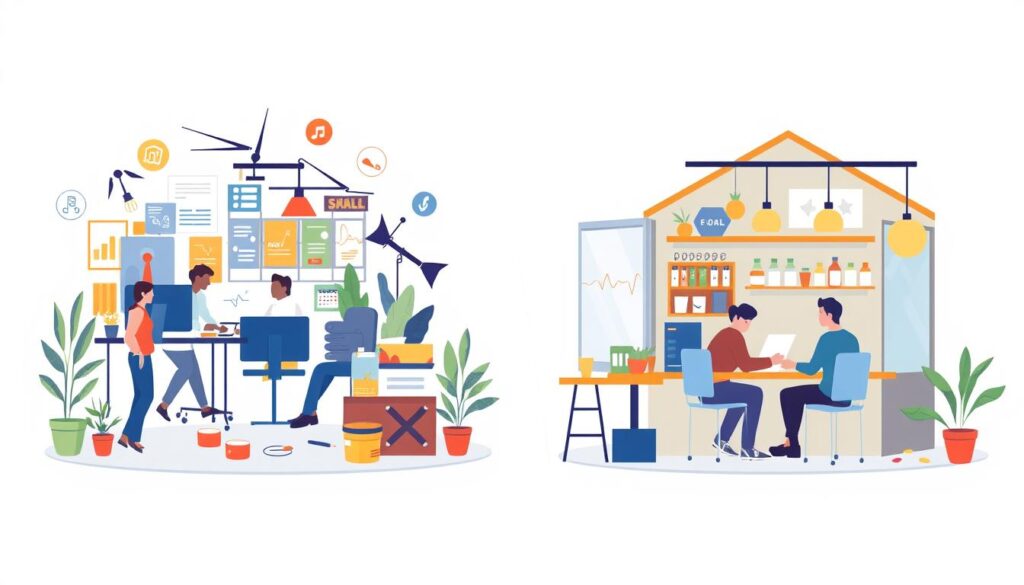
Main points:
- Startups emerge in response to market gaps and value agility.
- Small businesses have solid and resilient structures.
- Lean methodologies in startups can lead to operational fragility.
- Traditional companies have a greater capacity for long-term investment.
- Innovation and learning are essential for both modalities.
What are Startups?
*Startups* focus on innovation and rapid growth.
They are different from traditional small businesses.
This is because they deal with uncertainty in a unique way and seek to revolutionize markets.

*Startups* want to attract investors to grow quickly.
They seek to generate profits quickly. Their business model must be repeatable and scalable to serve more users.
| Indicator | Detail |
|---|---|
| Maximum Revenue | 16 million reais per year |
| CNPJ Registration Time | Up to 10 years |
| Fastest Unicorn | Loft – 16 months |
| Largest Collection | Stone – US$1.2 billion |
| Unicorn Companies in Brazil (2019) | 5 |
*Angel investors* are essential for the growth of startups.
They provide seed capital. They receive preferred shares, profiting if the startup grows.
Companies like Gympass and Movile are examples of success. They boast high market valuations.
The internet helps digital startups reduce costs and increase accessibility.
Read also: Zero-Based Budgeting: What It Is, Benefits, and How to Apply It
Characteristics of Small Businesses
To the small businesses are very important for the economy.
They offer services and products to the local market. According to the IBGE (Brazilian Institute of Geography and Statistics), a small business has between 20 and 99 employees in the industry.
In commerce and services, the number varies from 10 to 49 employees.

THE definition of small businesses is linked to its stability and ability to generate revenue.
They are different from startups, which seek innovation and rapid growth.
Small businesses focus on a secure return on their initial investment.
They operate in known markets, meeting consumer needs.
This makes them thrive with loyal customers.
They prefer proven methods, knowing their daily operations well.
Small businesses are often financed by their founders, family members, or bank loans.
This allows for more direct financial control.
They are essential to strengthening regional economies, generating jobs and providing essential services.
Startups vs. Small Businesses: Key Differences
THE comparison between startups and small businesses shows important differences.
Startups like Uber and Facebook grow quickly and change the market.
Small businesses, on the other hand, seek stability and serve local customers.
Let's take a closer look at these differences.

In Portugal, SMEs have fewer than 250 employees and an annual turnover of up to 50 million euros.
Startups start with 2-4 founders and initially have fewer than 10 people.
Financing is a key point.
Small businesses often use bank loans or their own savings.
Startups, however, rely on investments from Business Angels and Venture Capital Companies.
| Aspect | Startups | Small Businesses |
|---|---|---|
| Scalability | High, they can increase the customer base quickly without increasing costs proportionally. | Limited, revenue and costs increase proportionally. |
| Risk | High, approximately 90% of startups fail within the first five years. | Moderate, established companies have a lower bankruptcy rate. |
| Innovation | Focus on disruptive innovation, rapid adaptation to market changes. | Traditional business models, slower organic growth. |
| Financing | Business Angels and Venture Capital Companies. | Bank loans and bootstrapping. |
| Team | Initially 2 to 4 founding partners, less than 10 people. | 10 to 500 employees depending on the business. |
| Objective | Rapid growth to attract investors. | Long-term sustainable products and services. |
The differences between startups and small businesses are clear.
They affect how each type operates and grows.
Knowing these differences helps you choose the best path for your professional goals.
Advantages of choosing a Startup
Choosing a startup can be a great decision for investors and entrepreneurs.
They offer growth and innovation.
Startups aim to grow a lot, reaching a large number of customers without changing much what they offer.
This makes them very attractive.
Startups grow fast and have a big impact on the market.
During the internet bubble, between 1995 and 2001, many IT companies grew very quickly.
This shows the potential return on investing in startups.
They arise from new opportunities, trends or solutions, which differentiates them from traditional companies.
Startups seek funding in various ways, including their own resources and angel investors.
Over time, they may seek investment in Private Equity, Crowdfunding, or Accelerators.
This helps them grow quickly, demonstrating interest in startups.
++ Taxes in Practice: How to Choose the Best Tax Regime for Your Company
Startup teams are small and diverse, which improves integration and business knowledge.
Additionally, offering shares encourages employee engagement.
This shows once again the advantage of investing in startups.
| Aspects | Startups | Small Businesses |
|---|---|---|
| Main Objective | Scalability | Survival and profit |
| Initial Financing | Bootstrapping, Angel Investor | Bank loans, Interest |
| Target Market | Unlimited | Local or Regional |
| Innovation | High | Modest |
| Team | Small and Multidisciplinary | Variable |
Startups vs. Small Businesses: Advantages of Choosing a Small Business
Investing in small businesses brings many benefits.
They provide initial security and help the local economy.
Small businesses don't need a lot of capital, which makes them more manageable.
They also create a family-friendly work environment and connect well with the community.
Technology helps small businesses cut costs. It makes expenses clearer and increases efficiency.
Technology also improves productivity by eliminating the need for manual controls.
This helps maintain the quality and efficiency of processes.
Small businesses are also important to the economy.
They represent 53% of the Brazilian trade GDP and employ a lot of people.
In 2023, they created more than 70% of new jobs in Brazil.
See the table below to better understand the contribution of small businesses to GDP and employability in Brazil:
| Indicator | M small businesses |
|---|---|
| Trade's share of GDP | 53% |
| Participation in Brazilian GDP | 27% |
| Open job openings (2023) | 70% |
| Total employment in the country | 60% |
Small businesses have export growth of over 20% per year.
This drives revenue above the pace of the economy.
Investing in small businesses strengthens the economy and creates a prosperous business environment.
How to Decide Whether to Invest in a Startup or Small Business
Choosing between investing in a startup or small business requires care.
It's important to know whether you have an investor profile that seeks risk or stability.
Startups are attractive to those who want rapid growth and are prepared to face uncertainty.
Startup investors look for high-growth business models.
They want social impact and a big market.
Small businesses offer stability and a more predictable return, perfect for those looking for quick profits.
Understanding the advantages and challenges of each model is crucial.
Startups have access to resources such as incubators and angel investors.
Small businesses, on the other hand, focus on specific niches and require good financial planning.
Operations like micro-SaaS show that low-cost models can be successful.
They allow entrepreneurs to maintain full-time occupations.
This shows the importance of a business planning realistic.
The Micro-SaaS community is diverse and dynamic. It has 7,000 active entrepreneurs, fostering networking and experience sharing.
In summary, choosing between a startup and a small business requires in-depth analysis.
You need to understand the business environment, available resources, and growth objectives.
A good one business planning is essential for success.
Startups vs. Small Businesses: Conclusion
The choice between startups vs. small businesses It depends on many things. This includes your ambitions, how you view risk, and your vision for the future.
Startups want to solve problems in new ways and grow fast.
Small businesses seek stability and profit, focusing on local niches.
Startups are more flexible and focus heavily on innovation. Small businesses, on the other hand, are more structured and avoid risks.
They often use bank money and profits to grow, while startups seek venture capital.
Before you decide, think carefully about these differences. They'll help you make a better decision.
Whether you're an innovative startup or a small business with secure growth, the choice is yours.
The important thing is that it meets your needs and dreams as an entrepreneur.
++ 5 Steps to a Well-Planned Annual Budget
