
How Economic Cycles Affect Small Businesses
How Economic Cycles Affect Small Businesses!
Advertisements
Have you ever wondered how the ever-changing economy can directly impact your business?
In this article, we'll explore how economic cycles affect small businesses.
These cycles include growth and decline phases.
Understanding these cycles is essential to the success of your business.
Let's talk about strategies to help your company deal with these cycles.
It is important to monitor the economy to make good decisions.
If you want to learn more about managing companies in economic cycles, this is the right place.

Main points covered
- Definition of economic cycles and its phases.
- Impact of each economic phase on small businesses.
- How expansion can create opportunities and recession can create challenges.
- Strategies for navigating economic cycles.
- Importance of monitoring economic indicators.
What are economic cycles?
You economic cycles show how quickly the economy changes.
They have phases of growth and decline.
To the understanding economic cycles, we see changes in production, employment, income and demand.
THE definition of economic cycles speaks of four phases: expansion, peak, contraction and recession.
These phases affect people's lives and companies.
Joseph Schumpeter spoke of four stages: boom, recession, depression, and recovery.
This shows that the economy is going through important moments.
Economists such as Kitchin and Kondratiev have proposed different durations for these cycles.
For example, Australia grew economically for 29 years without a recession, from 1991 to 2020.
Irving Fisher and Hyman Minsky explained business cycles.
Fisher argued that credit can cause growth. Minsky used credit to explain cycles.
In expansion, GDP grows, production increases and unemployment decreases.
In a recession, everything declines and unemployment rises.
There are several types of economic cycles.
Juglar's lasts 7 to 10 years. Kuznets's lasts 15 to 20 years.
And Kondratiev's, 50, are linked to technological innovations.
In Brazil, between 1980 and 2019, there were 9 economic cycles.
The expansion lasted 34 months and the recession, 19 months. Consumer confidence changes with these phases.
Leading indicators help predict these changes.
FGV IBRE and The Conference Board create these indicators. They help understand economic cycles.
++ How does the dollar affect product prices in Brazil? Learn more!
Main phases of economic cycles
Understand the phases of economic cycles is crucial for small businesses.
They need to adapt their strategies to grow.
Economic cycles have four main stages, each with its own characteristics and impacts on the economy.
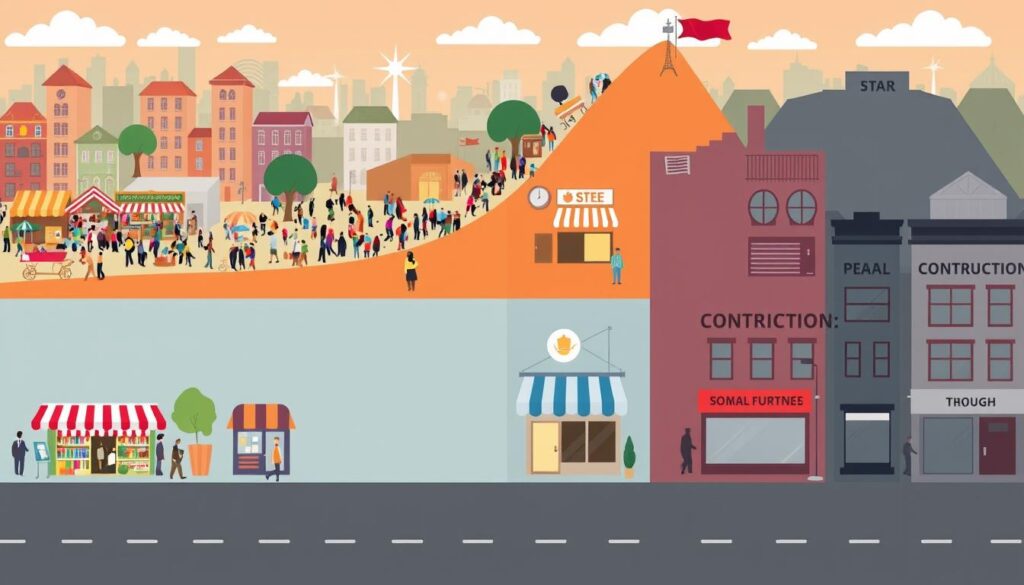
Economic Expansion: In the phase of economic expansion, unemployment is low and production is increasing.
GDP is growing and consumer and investor confidence is high.
Peak: The peak is the highest point of the cycle. The economy reaches its peak.
Demand for goods and services is high, which can cause inflation.
Contraction: Contraction is when economic growth slows down.
Unemployment rises and prices may fall. Companies cut investments and costs.
Recession: Recession is the most difficult phase.
There's a major economic downturn, with high unemployment rates. High interest rates also affect consumption.
| Phase | Features |
|---|---|
| Expansion | GDP growth, low unemployment rate, increased production |
| Peak | Maximum economic growth, high demand and possible inflation |
| Contraction | Slowing growth, rising unemployment, reduced investment |
| Recession | High unemployment rate, economic downturn, reduced consumption |
How Economic Cycles Affect Small Businesses
Small businesses and economic cycles are linked.
Each phase of the cycle affects these companies differently. During expansion, they have a greater chance of growth.
However, they face the challenge of meeting increased demand without losing quality.
THE impact of economic cycles can be a major challenge. It can either help growth or cause financial problems.
In contraction and recession, the challenges are greater.
Default rates increase when consumers experience financial difficulties. Access to credit becomes difficult.
The technical recession, with two quarters of GDP decline, puts even more pressure on the situation.
Sectors such as health and education can be more resilient.
But effective financial management is essential for everyone.

The following table shows how operating variables are affected in different phases of economic cycles:
| Indicator | Value | Observation |
|---|---|---|
| Average stock | R$ 22,000.00 | Impacts liquidity |
| Cost of goods sold (COGS) | R$ 30.00 | Influenced by input prices |
| Average storage period (ASP) | 2.03 days | Indicates sales efficiency |
| Economic Cycle (EC) | 35 days | Operational turnaround time |
| Average Accounts Receivable Term (PMCR) | 60 days | Time to receive credit sales |
| Operating Cycle (OC) | 95 days | Full cycle of operation |
| Average supplier payment term (PMPF) | 30 days | Payment terms to suppliers |
| Financial Cycle (CF) | 65 days | Indicates the duration of the own financing |
A difficult financial situation leads to the use of third-party capital.
This increases financial costs and risk. Annual inventory turnover helps with cash flow.
But in a recession, it is crucial to adapt financial strategies to overcome the challenges of the impact of economic cycles.
++ The Benefits of Correctly Filing Personal and Corporate Income Tax Returns
Impacts of expansion on small businesses
Economic expansion brings benefits for small businesses.
They see an increase in demand for their products and services.
Furthermore, they have greater access to credit and can grow more easily.
Consumers are more willing to spend during this phase.
This encourages companies to innovate and launch new products, allowing them to stand out in the market.
Small businesses can grow efficiently during economic expansion.
With more resources, they can invest in technology and infrastructure.
This is essential for the development and strengthening of the business.
Expansion is crucial for small business growth.
It positively impacts GDP and operational development. Here's how:
| Economic Cycle Phase | Features | Impacts on Small Businesses |
|---|---|---|
| Expansion | GDP growth, increased demand, greater access to credit | Possibility of investing in new products, expanding operations, hiring more employees |
| Peak | GDP at its highest level, demand potentially exceeding productive capacity | Demand management and expense control challenges |
| Contraction | Fall in GDP growth, rise in unemployment, reduction in consumption | Need for cost control, strengthening liquidity, adapting to market changes |
| Recovery | GDP growing again, economic stabilization | Preparation for rapid scaling of operations, taking advantage of new market opportunities |
The expansion phase is the best time for small businesses to strengthen their position in the market.
With good planning, they can make the most of the benefits from the economic expansion.
This ensures sustainable growth.
Challenges faced by small businesses during the contraction
Small businesses in Brazil, which account for 99% of the total, face many challenges.
A drop in sales affects cash flow. This can lead to cost cuts and internal changes.
Furthermore, access to financing is difficult.
These problems are more severe during economic contraction.
Managing small businesses in difficult times requires effective strategies.
By 2014, there were 9 million Micro and Small Enterprises (MSEs) in Brazil. They account for 30% of the country's GDP.
Maintaining cash flow and increasing efficiency are common strategies.
Renegotiating debts and contracts also helps alleviate financial pressure.
Internal management is crucial for survival.
Small businesses are essential to the economy.
They generate 72% of vacancies in the first half of 2022.
Bureaucracy and high taxes are among the main reasons why SMEs close.
Therefore, careful planning and effective management are essential.
They help overcome challenges and keep the company running.
Effects of the recession on small businesses
THE economic recession is a big challenge for small businesses.
It brings a prolonged decline in economic activity, affecting household income and business activity.
In a recession, sales and revenue for small businesses drop sharply.
Unemployment increases, decreasing consumers' purchasing power.
This leads to less demand for products and services.
Small businesses need to streamline their operations.
Many are suspending investments, such as purchasing new equipment, to try to survive this difficult time.
In a technical recession, a country's GDP declines for two consecutive quarters.
This shows the serious economic impact.
Recessions often lead to millions of unemployed people and business closures.
The COVID-19 pandemic was an example.
It lasted only a few months, but had a huge impact on employment and the sustainability of small businesses.
Nearly 70% of US GDP comes from consumer spending. This shows how a recession can affect the global economy.
To weather the recession, small businesses can diversify their products and services.
This helps reach new markets and reduces dependence on a single recipe.
Renegotiating debts is also essential to better manage cash flow and avoid default.
| Indicator | Before the Recession | During the Recession |
|---|---|---|
| Unemployment | Low | High |
| Purchasing Power | High | Low |
| Investments | Expanding | Suspended |
| Corporate Revenue | Stable/Growing | Reduced |
The recession can be very difficult, but small businesses can adapt.
With the right strategies, they can not only survive, but grow when the economy improves.
++ Finance for the Self-Employed: Tips for Those Without a Fixed Income in Brazil
Strategies for small businesses to navigate economic cycles
Adapting to economic cycles is essential for the survival of small businesses.
Effective business strategies can make all the difference.
Developing a solid financial plan is essential.
Maintaining a robust cash reserve and diversifying revenue sources are best practices.
This ensures the stability of the company.
During boom times, small businesses have the chance to grow rapidly.
Demand for your products and services increases, resulting in higher revenue and profit.
Investing in innovation is also advantageous, with 60% of companies managing to maintain or increase their dividends.
On the other hand, during periods of contraction and recession, the challenges intensify.
About 40% of small businesses close during prolonged recessions.
Adapting to economic cycles efficiently is essential.
Cost cuts and operational improvements can reduce expenses by up to 20%.
Reviewing operating expenses is critical to adapting to new economic conditions.
Adopting cost control strategies at the peak of the cycle is vital.
Demand may exceed production capacity.
Liquidity becomes crucial during the contraction phase; strengthening cash reserves ensures the continuity of operations.
During the bottom of the cycle, it is strategic to acquire undervalued assets.
Taking advantage of government tax incentives strengthens the company's financial health.
Small businesses should conduct strategic planning once or twice a year.
This keeps goals and actions well defined.
Improving business management and defining financial priorities are essential.
Tools like SWOT analysis are essential for identifying internal and external factors.
They impact the company's performance.
The use of technology and data is crucial for effective financial analysis and management.
Financial software helps with cash flow control.
They provide a clear view of financial analyses, facilitating more informed decision-making.
Importance of monitoring economic indicators
It is crucial to monitor economic indicators so that companies anticipated changes.
Gross Domestic Product (GDP) and unemployment rate are essential.
They help to understand the economy and guide the business strategies.
For more in-depth analyses, the Broad National Consumer Price Index (IPCA) and the General Register of Employed and Unemployed Persons (CAGED) are important.
They show inflation and the formal labor market.
The Monthly Industrial Survey – Physical Production (PIM-PF) and the Monthly Trade Survey (PMC) are also crucial.
They help to understand the industry and retail.
This data is essential for the economic monitoring.
The Economic Activity Index (IBC-Br) is another important indicator.
It is published monthly and helps anticipate GDP.
This influences the Central Bank's decisions on interest rates.
You economic indicators are classified as antecedent, coincident and lagged.
Each has a different impact on the economy.
By combining these indicators, companies can gain a complete picture of the economy.
This helps reduce risks and seize opportunities.
Economic Cycles: Conclusion
Understanding economic cycles is essential for small businesses.
This helps predict and respond to market changes.
With this knowledge, you can see patterns and prepare for challenges and opportunities.
In Brazil, several economic cycles were important.
For example, brazilwood, sugar, gold and coffee.
In addition, cotton and rubber also played a large role.
These cycles shaped the country's economy and taught us about the resilience of companies.
To deal with economic changes, it is important to monitor indicators and be proactive.
With a good understanding of economic cycles, small businesses can thrive.
Staying informed and prepared is crucial to facing changes.
