
How small Brazilian businesses are using hybrid cloud.
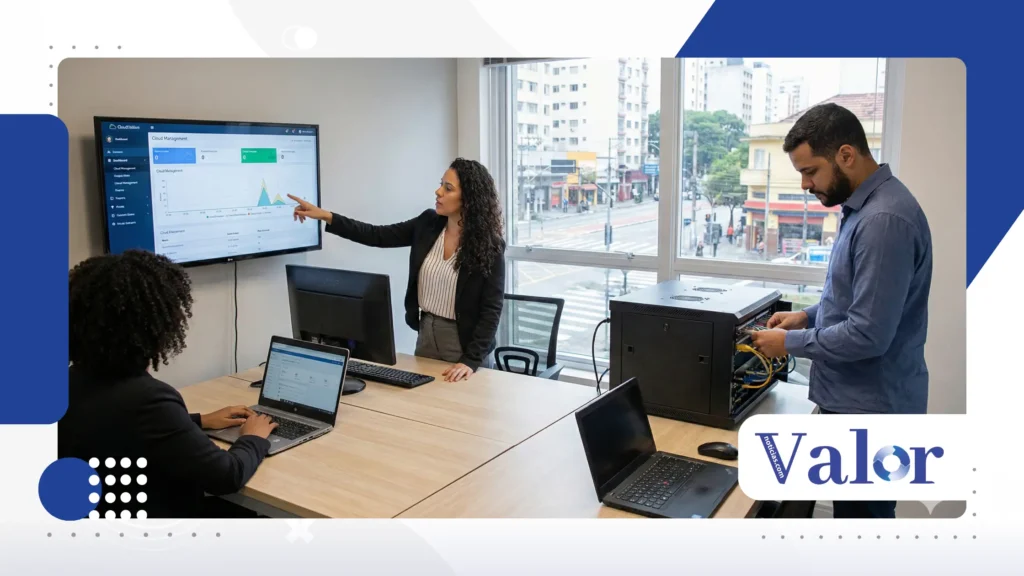
Currently, we note that Brazilian companies are using hybrid cloud. as a vital tool to ensure financial and operational sustainability.
Advertisements
The economic landscape of 2025 demands that managers seek maximum efficiency in their investments.
Technology has ceased to be merely a technical support and has become the heart of business strategy.
Small business owners have realized that relying exclusively on physical servers is risky and expensive.
On the other hand, migrating everything to the public cloud can generate unpredictable costs, especially with currency fluctuations. The hybrid model then emerges as the ideal solution to this financial dilemma.
In this article, we will explore how this architecture is saving budgets and driving the growth of SMEs in Brazil. We will analyze real data, tangible benefits, and the direct impact on cash flow.
Summary:
- What defines the hybrid cloud for the small business owner?
- Why does economic stability require digital flexibility?
- What are the direct impacts on cost reduction (OPEX vs CAPEX)?
- How does data security influence investment decisions?
- Comparative table of efficiency and costs.
- Which sectors are leading this transformation in 2025?
- FAQ (Frequently Asked Questions).
What defines the hybrid cloud for the small business owner?
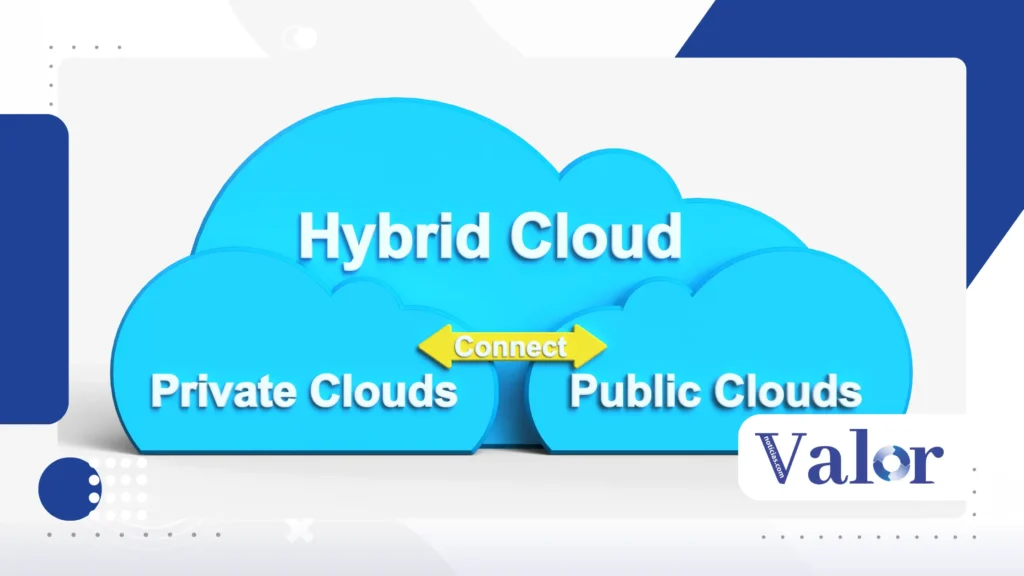
Many managers still misunderstand the concept, imagining it to be a complex and inaccessible technology. Hybrid cloud is, in fact, the intelligent combination of two distinct worlds.
It integrates on-premise infrastructure or a private cloud with public cloud resources such as AWS, Azure, or Google Cloud. This fusion enables dynamic orchestration of data and applications.
For a gourmet bakery or a small financial consultancy, this means keeping sensitive data in-house.
At the same time, they use the public cloud to run resource-intensive systems or store backups.
There's no need to abandon the servers the company has already purchased and paid for. The hybrid model leverages existing infrastructure, avoiding the waste of capital previously invested in hardware.
Interoperability is key to this system, allowing workloads to move as needed. The resulting flexibility is what attracts so many businesses with limited budgets.
This architecture eliminates the need to choose between total security or infinite scalability. Brazilian entrepreneurs can finally have the best of both worlds without compromising the company's cash flow.
+ Credit cards with access to VIP lounges: Which ones offer the best value for money?
Why does economic stability require digital flexibility?
The Brazilian market in 2025 continues to present challenges, with the volatility of the dollar impacting technology contracts.
Public cloud services are often pegged to the US dollar, which increases the cost of operation.
By maintaining predictable workloads on local servers, the company partially protects itself against currency fluctuations. The cost of electricity and local maintenance is paid in reais (Brazilian currency).
The public cloud, on the other hand, is only activated for peak demand or specific innovations. This intelligent management of IT consumption acts as a financial hedge against technological inflation.
Companies that lack this flexibility end up paying for idle resources in the cloud or suffering from slow local servers.
Infrastructural rigidity is, today, one of the biggest enemies of profit margins.
The ability to quickly scale resources up or down is essential in a dynamic economy. If sales fall, the company shuts down cloud resources and reduces its bill immediately.
This financial agility is impossible in the traditional model, where the purchased server represents a sunk fixed cost. The hybrid cloud transforms heavy fixed costs into adjustable variable costs.
+ Early Christmas shopping: why "buying early" can save you money.
What are the direct impacts on cost reduction?
Understanding the difference between CAPEX (capital expenditures) and OPEX (operating expenses) is fundamental to this analysis. The hybrid model allows for a healthy balance between these two types of spending.
Small businesses often lack the working capital for large acquisitions of new servers.
Using the public cloud for expansion avoids this immediate outlay of large sums of money.
Simultaneously, using private infrastructure for static data reduces data transfer rates (egress fees). These fees are often the hidden culprits in public cloud bills.
Market studies indicate that efficient workload management can reduce TCO (Total Cost of Ownership). The savings generated can be reinvested in... core business of the organization.
To better understand how technology trends impact company budgets, it is recommended to read market reports. Access detailed analyses on IT spending and cloud trends on the Gartner portal..
Budget predictability improves significantly when the hybrid environment is mastered.
The financial manager can project expenses with greater accuracy, avoiding unpleasant surprises at the end of the month.
+ Broadband internet and cell phone plan costs: comparison between operators
How does data security influence investment decisions?
The General Data Protection Law (LGPD) remains a central concern for companies of all sizes. Fines for data breaches can drive a small business into bankruptcy.
Maintaining critical customer data in a private infrastructure offers tighter control over information sovereignty. The entrepreneur knows exactly where the data physically resides.
However, the public cloud offers advanced cybersecurity tools that would be unaffordable for an SME. Next-generation firewalls and AI-powered threat detection are clear examples.
The hybrid strategy allows the security layer of the public cloud to be applied over private data. This creates a robust ecosystem that protects the company's reputation and assets.
Redundancy is another crucial factor for business continuity in the event of disasters. If the local server fails, the cloud takes over, ensuring that billing doesn't stop.
Investors and business partners value companies that demonstrate maturity in managing digital risks. Hybrid security, therefore, becomes a competitive differentiator and a powerful selling point.
Table: Real Comparison of Financial and Operational Efficiency
Below, we present consolidated data based on market averages for SMEs in 2025. The comparison aims to demonstrate where the hybrid model stands out financially.
| Criteria Analyzed | Local Server (On-Premise) | Public Cloud 100% | Hybrid Cloud |
| Initial Cost (CAPEX) | High (Hardware Purchase) | Low (Zero Hardware) | Moderate (Take advantage of the legacy) |
| Monthly Cost (OPEX) | Low (Power/Maintenance Only) | High (Variable in Dollars) | Optimized (Balance) |
| Data Control | Total (Local sovereignty) | Shared (Provider) | High (Critical Local Data) |
| Network Latency | Minimum (Local Network) | It depends on the connection. | Low (Edge Processing) |
| Scalability | Limited and Slow | Immediate and Infinite | Flexible and Controlled |
| Security (Disaster Recovery) | Low (Local physical risk) | High (Global redundancy) | Maximum (Double Layer) |
Data based on IT infrastructure performance metrics for the Brazilian service and retail sector.
Which sectors are leading this transformation in 2025?
Retail is one of the major players, using the hybrid cloud to manage inventory in real time. Physical stores maintain local servers to ensure the operation of their point-of-sale (POS) systems.
This prevents the system from shutting down if the internet goes down, something common in many regions of Brazil. Simultaneously, sales data is synchronized in the cloud for BI analysis.
The financial sector, including fintechs and accounting firms, is also massively adopting this model. They need zero latency for transactions, which local processing effectively guarantees.
The healthcare sector, including clinics and laboratories, utilizes hybrid storage for imaging exams. Large files are kept locally for quick access, while secure backups are stored in the cloud.
Logistics companies use edge computing integrated with the cloud. Trackers send data to local servers in distribution centers, optimizing package sorting.
This versatility proves that no sector is immune to the benefits of hybridization. Adaptation is the rule for those who wish to maintain competitiveness and financial health.
How to plan a migration without halting operations?
The first step is to conduct a detailed inventory of all the company's applications and data. It is necessary to classify what is critical, what is sensitive, and what is ancillary.
Do not attempt to migrate everything at once, as this will almost certainly cause service disruptions. A phased approach is the one most recommended by experts to mitigate operational risks.
Start by moving less critical workloads, such as email and collaboration tools, to the public cloud. Keep the ERP and the main database on the local server initially.
Empowering your internal team or hiring a specialized consultancy is an indispensable investment. Lack of technical knowledge is the main cause of failures and budget overruns.
Constantly monitor performance and costs throughout the transition process. Fine-tuning will be necessary to find the sweet spot between technical performance and financial savings.
Conclusion
It becomes clear that the way Brazilian companies are using hybrid cloud. This reflects a level of management maturity.
The pursuit of financial efficiency drives the adoption of smarter and more adaptable technologies.
It's not about following a technological trend, but about structuring the business for longevity. The ability to adapt defines who remains in the market in the coming years.
Data sovereignty and cost control are the greatest advantages of this strategy. The entrepreneur regains control of their infrastructure, without being held hostage by a single model.
By 2026, the trend is for automation and artificial intelligence to be integrated into these hybrid environments. Preparing the ground now is key to securing a competitive advantage in the near future.
Adopting a hybrid cloud is, above all, a decision of financial intelligence. It's about doing more with less, protecting the company's assets and ensuring the delivery of value to the customer.
To deepen your knowledge of digital security and regulation standards in Brazil, visit the official website of... National Data Protection Authority (ANPD).
FAQ (Frequently Asked Questions)
1. Is hybrid cloud more expensive for small businesses?
Not necessarily. While there may be local maintenance costs, the savings generated by avoiding cold data storage in the public cloud often offset this, balancing the final budget.
2. Do I need a large IT team to manage this?
Having a large in-house team isn't mandatory. Many SMEs hire managed IT services (MSPs) that handle the technical complexities, allowing them to focus on their core business.
3. Is my data more secure in a hybrid or public cloud?
The hybrid cloud offers an extra layer of security by allowing highly sensitive data to remain in a private environment while leveraging the advanced defense tools of the public cloud.
4. What happens if my company's internet goes down?
This is the great advantage of the model. Critical operations running on the local server continue to function, ensuring that billing and customer service do not stop during the outage.
5. How do I know if my company is ready to migrate?
If your company is facing high IT costs, latency issues, or concerns about the LGPD (Brazilian General Data Protection Law), now is the ideal time. Conduct a technical audit to design the project.
